
How to Make Zinc Cut Stars
Introduction
Now and then on the pyro discussion lists someone will bring up the subject of zinc stars. Usually several folks will chime in with, "Oh, man, those stars are some of my favorites, so subtle and beautiful."
In Chapter 15 on Fireworks, of Alexander Hardt's Pyrotechnics, (this chapter written by Barry Bush after Dr. Hardt's death), it is stated, "Good zinc stars are blue-green with tails of delicate gold, and seem rather exotic today."
This is a color star where the color is produced by an elemental metal, rather than a metallic salt, such as when a blue is produced with a copper oxide or carbonate. So, this blue-green color star may be among the oldest star colors that were produced.
Back in the early 90's when I first started making stars, there was not much fireworking information available. I was able to get my hands on a copy of the then recently reprinted Pyrotechnics, by George Weingart. Some of my first star-making efforts were based on a few of the formulae contained in that book, and perhaps my favorite of them was the Granite Star.
An added bonus is that this is one of the easiest cut stars to make that I've tried.
Granite Star formula (all parts are by weight):
| Component | Parts | Percent | Decimal |
| Potassium Nitrate (KNO3) | 14 | 22% | (0.22) |
| Zinc dust | 40 | 62% | (0.62) |
| Fine charcoal | 7 | 11% | (0.11) |
| Sulfur | 2.5 | 4% | (0.04) |
| Dextrin | 1 | 2% | (0.02) |
| Totals | 64.5 | 101% | (1.01) |
(The percentages, because of number rounding, actually add up to 101%, but that's OK, and they'll work just fine. The percentages of each individual chemical in the composition are calculated by taking the original number of parts of that chemical, say 14 parts of KNO3, and dividing that number by the total number of parts, 64.5 in this case. 14/64.5=.217, which can be rounded to .22, which is 22 hundredths or 22%.)
Note: You may be saying to yourself, "I wonder why he's including those decimal numbers after the percentage numbers." I'll show ya in a minute. The decimals are much more useful than the percentages.
Recently, Harry Gilliam, in a Skylighter Fireworks Tips Newsletter, published the formulae that he inherited from the Kosankes when he purchased the business that became Skylighter. In that list of formulae is one called Pearl, and it is a slightly different version of a zinc star:
Pearl formula (all parts are by weight):
| Component | Parts | Percent | Decimal |
| Potassium Nitrate | 35 | 35% | (0.35) |
| Airfloat charcoal | 15 | 15% | (0.15) |
| Zinc dust | 40 | 40% | (0.40) |
| Sulfur | 5 | 5% | (0.05) |
| Dextrin | 5 | 5% | (0.05) |
| Totals | 100 | 100% | (1.00) |
I always like to look at star formulae and see how they differ from each other. It can be seen that the second formula uses less zinc, more KNO3, and slightly more charcoal, sulfur and dextrin.
There is a formula in Hardt's book that is similar to the Kosanke formula above, but the zinc is increased to 45%, and some Meal D black powder is used in it, as well as potassium nitrate, charcoal and dextrin.
I, personally, have only made zinc stars using the first formula, from Weingart, the Granite Star.
In a recent discussion in the Passfire.com Forum, a fellow fireworker, who has worked quite a bit with this star, recommended that that the charcoal used in the formula be half airfloat and half 80 mesh. This improves the charcoal tail that the star leaves behind as it burns. Back in the '90's when I made the star, I'd only use airfloat, so this is another area of experimentation as an individual fine tunes the formula to his own personal tastes.
These stars light easily, especially when made as cut stars with all the corners and edges to take and hold fire, so I've always just primed them with a "scratch-mixed" (mixed by hand, no milling) black powder prime, simply screened through a 40 mesh screen.
Black Powder Prime (all parts are by weight):
| Component | Parts | Percent | Decimal |
| Potassium Nitrate | 75 OR 15 | 75% | (0.75) |
| Airfloat charcoal | 15 OR 3 | 15% | (0.15) |
| Sulfur | 10 OR 2 | 10% | (0.10) |
| Dextrin | 5 OR 1 | +5% | (0.05) |
| Totals | 105 OR 21 | 105% | (1.05) |
Note: This is simply 75/15/10, KNO3/charcoal/sulfur (the classic black powder proportions), with an additional 5 parts of dextrin added as a binder (additional 5%). One of the few formulae that I can always remember off the top of my head is the 15/3/2/1 parts proportion of this composition. If I want to make 21 ounces of prime, I simply weigh out 15/3/2/1 ounces of each chemical and screen them together.
How Much of this Star Should I Make?
This is a very heavy and dense star, perhaps the heaviest I have ever made. (I haven't made stars using gold powder yet!) A 4" ball shell will use a little less than a pound of these primed stars. A 4" mine would use about the same amount. In my small-scale, hobbyist fireworking endeavors, I actually like making stars a pound at a time, especially when experimenting with new formulae.One pound of zinc Granite Stars
Using the first formula, above:| Component | Decimal | Batch Weight |
Weight | ||
| Potassium Nitrate | 0.22 | x | 16 oz. | = | 3.5 oz. |
| Zinc dust | 0.62 | x | 16 oz. | = | 9.9 oz. |
| Fine charcoal | 0.11 | x | 16 oz. | = | 1.75 oz. |
| Sulfur | 0.04 | x | 16 oz. | = | 0.65 oz. |
| Dextrin | 0.02 | x | 16 oz. | = | 0.3 oz. |
| Totals | 1.01 | x | 16 oz. | = | 16.1 oz. |
Now do ya see how handy those decimals are? Of course, any final batch size can be plugged in instead of the 16 oz. A 32 oz. batch, or a 100 gram batch, can be calculated just as easily.
The charcoal can be all airfloat, or it can be half-and-half airfloat and 80 mesh, as mentioned above.
The potassium nitrate should be milled first to make sure it's nice and fine. A ball mill will do the job but a blade-type coffee grinder works just as well and you can get them for about $10 at Walmart. Be sure to mark the one that you use for this as oxidizers only! You never want to grind fuels in the same grinder you've used for oxidizers.
Zinc
What the heck is zinc, anyway? I don't know about you, but zinc is not one of those chemicals I'm all that familiar with. In the back of my head all I kinda knew about zinc was that it was coated onto the steel garbage cans of my youth to keep them from rusting. Galvanization they called it. Same stuff that's on the steel ductwork leading to and from my furnace. I actually had to look zinc up to verify that it is, indeed, an element like gold and copper. Shows ya how much of a chemist I am.An interesting thing about the powdered zinc that we use in Granite Stars is that it doesn't stay powder for long. It forms clumps. Either at the supply house, or in our storage, zinc powder will become zinc clumps, because it oxidizes in moist air.
Unless these clumps have been allowed to harden for years, they can be broken up simply by rubbing them on a 100 mesh screen. I recently received a shipment of zinc dust which had formed these clumps, and I was quickly able to return the metal to a dust through my screen.
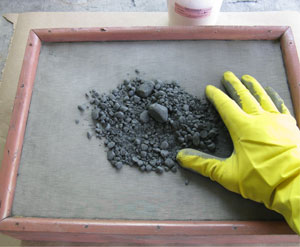 Screening Zinc Clumps
Note: Zinc is reportedly not toxic, but I can tell you from experience that it is irritating if it is inhaled during the above screening process, or during the manufacture of zinc stars. I mean Really Irritating in the nasal passages. I'm not saying this as some kind of CYA. Wear a good respirator when working with zinc dust. Really, no kidding.
I use a good, $25 respirator, from Home Depot which is rated for fine dusts as well as fumes.
 Buy & Use a Good Respirator
Making Zinc Cut Stars
Zinc stars burn relatively slowly, and if they are made too large they will burn all the way to the ground, especially if used in a mine. Therefore, I like to make the stars a bit on the small side. For 4" shells and mines, I like to cut the stars 5/16" square, and once they are primed they end up being about 3/8" square. For a more dense spray of stars, they could even be cut 1/4" and this would work well for smaller shells as well.I am working outdoors and away from any sources of ignition.
I have screened 21 oz. of my BP prime through my 40 mesh screen and I have it in a closed container. I always keep every flammable composition in closed containers until they are actually being used. This minimizes the amount of exposed materials in case there is a stray spark or fire.
I have screened my 9.9 oz. of zinc through my 100 mesh screen.
I weigh the rest of my chemicals into individual containers, add them all together with the zinc, and screen the complete composition 3 times through my 40 mesh screen to completely pulverize and mix the components.
Then I weigh the composition in a plastic bucket to make sure that it totals up to the 16.1 ounces of weight that it should, thereby insuring that I didn't make any mistakes when weighing the individual chemicals, or leave one out completely. This step can prevent a lot of mistakes and wasted chemicals.
I put a lid on the bucket and shake it to further mix the ingredients.
Then, with rubber-gloved hands, I start to work water into the composition until workable putty is developed. It's OK to start adding water out of a jug a little at a time, until the composition starts to get dampened. But, the final increments of water ought to be added by spraying it out of a little, plastic spray bottle. This prevents the addition of too much water, which makes for a pain in the butt. It's always easier to add a bit more water than it is to remove a little.
As I add the water, the comp will clump-up, form a hard ball, and finally, when enough water has been worked in, it forms a nice, workable ball of dough which will flatten out smoothly when patted with a hand. My one-pound batch of star-comp required 2.6 ounces of water to get to this point, which is about an additional 16% (0.16) by weight.
I have two, 14" x 17," 3/8" thick, black-plastic cutting boards from Kmart or Target that I use to cut stars on. I'll take one of the cutting boards, cover it with wax-paper, put the star dough-ball on it, and put 5/16" spacer dowels on either side of the comp.
Then I'll flatten the ball by hand a bit and cover it with another piece of wax paper. Then, using a rolling pin or a rocket tube, I'll further flatten the comp until it's just as thick as the spacer dowels, 5/16" in this case.
 |
 |
Now, the top piece of wax paper is removed and set aside, and the spacers are removed, too. The tub of star-prime is opened and some of it is evenly dusted onto the pancake using a small cup or a measuring spoon.
 |
 |
The piece of wax paper is replaced on top of the pancake. Then fold the edges of the bottom and top pieces of paper together a couple of inches.
 Folded Edges of Wax Paper
You'll see how helpful this step is in a minute. Then place the other cutting board on top of it all, press down a bit to compress the prime onto the pancake, and lift both cutting boards and flip them over, keeping the folded edges of the wax paper down so that the loose prime can't fall out from between the pieces of paper.
Remove the top cutting board and the top piece of wax paper. Now, dust the exposed side of the pancake with prime so that both sides have been coated in the prime.
 Other Side Pancake, Now Primed
Now we're ready to do some star-cutting. I love the knife that a fellow pyro turned me onto years ago, that I use for cutting stars. It's a thin-bladed, very sharp, very straight edged, meat-slicing knife from McMaster-Carr. It costs $26 nowadays, and is part number 3851A11.
I cut and filed off the little plastic handle extension that hung down below the edge of the blade so that I could press the blade all the way down to the cutting board.

Great Knife for Cutting Stars
I start cutting the pancake of star comp into strips 5/16" wide, sliding the strips aside and flipping them over so that the primed edges are against each successive strip.
Note: The star comp can try to stick to the knife during this process. If a strip is clinging to the knife, it's easy to raise the knife a bit and rap its end on the cutting board, knocking the strip downward and off of it.
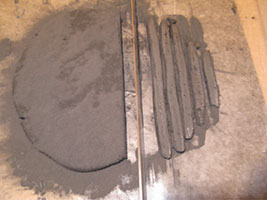 |
 |
Then I sprinkle more prime on the strips, put the wax paper on the strips, fold over the edges of the two layers of paper again, put on the other cutting board, and flip the whole deal, keeping the folded paper edges down again. The top cutting board is removed as well as the top piece of paper, and that side of the strips is now dusted with prime.
Star prime is your friend in this process, and later on when you use the stars in a device. Don't use is sparingly. Use it liberally. Bam. Just like that cooking guy, what's his name? Emeril, yeah, that's it.

Strips of Star Comp Dusted on Both Sides with Black Powder Prime
The strips are now cut into 5/16" cubes, with the rows of cubes being flipped over as much as possible to keep primed edges touching each other.
 |
 |
Now, it's easy to raise the edges of the wax paper and roll the stars onto each other, breaking up any that are clinging to each other, and fully coating all the cut sides with prime.
I like to dump the whole mess into a large plastic container, swirl them around a bit, and lightly spritz the stars with the water sprayer until they have fully gathered all of the star prime onto themselves. If I get them a little too wet, I add more prime, until a nice, thick, consolidated layer is on them.
In this instance, this one-pound batch of 5/16" stars used 6 ounces of the star prime.
Note: The above process is actually the beginnings of a simple, hand-rolled, round star production method. In a future article I'll use 1/8" zinc stars as the cores upon which to roll some round charcoal stars. These zinc stars make easy-to-handle, dense star cores for this procedure.
Then I spread the stars out onto a drying screen to dry in the warm air, or to be put into the drying chamber detailed in the Project Plans on the Skylighter website.
 |
 |
Testing the Zinc Stars
For purely scientific reasons, and not at all because I was impatient to see these babies in action, as soon as the stars were dry, which took about a week in the open air, or a few days in the drying chamber, I took a few of them out and fired them out of the star testing gun. Man, they are purty!
Testing Zinc Stars with the Star Testing Gun
Note: the 5/16" stars, which ended up being about 3/8" including the prime, worked well in the 1/2" star-gun tube, and required a flat 1/8 teaspoon-full of FFG sporting grade black powder to lift them. I also have some 1/2" stars which work well in the 5/8" tube, and require a heaping 1/8" teaspoon of the lift powder.
Since cut stars may not drop smoothly into the star-gun tubes because of their edges and corners, I use a thin dowel to push them down into the tube and to make sure they are seated against the lift powder.
Putting the Zinc Stars to Good Use
In a Skylighter Fireworks Tips Newsletter, I used these stars to make a really nicely performing 4" plastic ball shell.See ya then, and Stay Green,
Ned